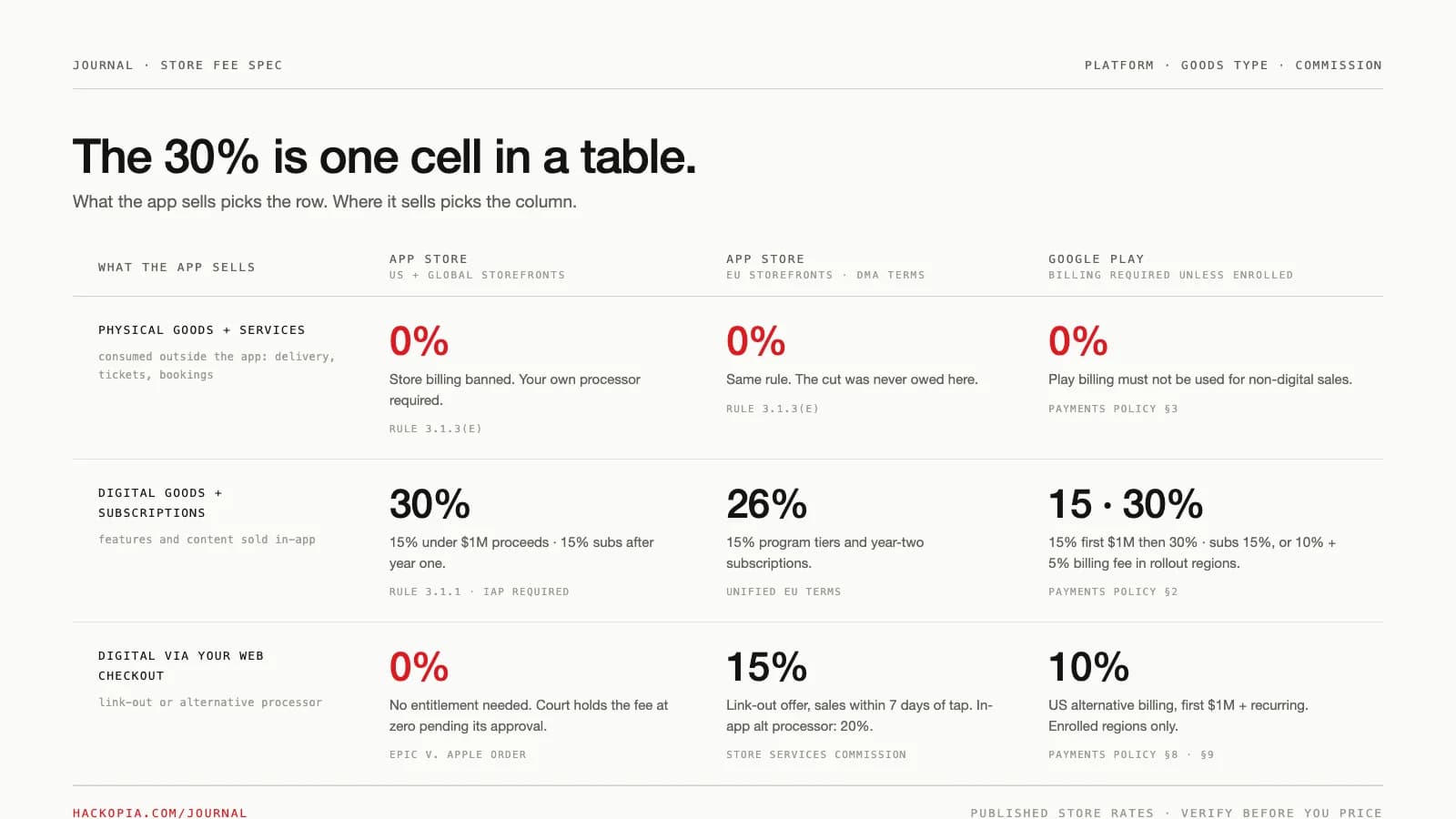
The app is scoped, the subscription is priced at $15 a month, and somewhere between the estimate and the signature the owner asks the question: "can we skip Apple's 30%?" It is a fair question, and the honest answer is not yes or no. It is a table. What the app sells decides the rule, then where it sells decides the rate. This post is the current version of that table, with the court rulings that redrew it.
The default rule
Start with the rule everything else is an exception to. Apple's Guideline 3.1.1: "If you want to unlock features or functionality within your app (by way of example: subscriptions, in-game currencies, game levels, access to premium content, or unlocking a full version), you must use in-app purchase." Google Play's Payments policy says the same in its own grammar: apps "requiring or accepting payment for access to in-app features or services, including any app functionality, digital content or goods ... must use Google Play's billing system for those transactions unless Section 3, 8, or 9 applies."
Both sentences draw the same line: if the thing being sold is digital and consumed inside the app, the store's billing is the toll road. Everything below is about the exits.
The goods that never pay the toll
The biggest carve-out is not a loophole, it is a prohibition. Apple 3.1.3(e): "If your app enables people to purchase physical goods or services that will be consumed outside of the app, you must use purchase methods other than in-app purchase to collect those payments, such as Apple Pay or traditional credit card entry." Play's policy runs the same direction: its billing system "must not be used" for physical goods (groceries, clothing, electronics), physical services (transportation, airfare, gym memberships, food delivery, event tickets), or bill remittance, and Google's own billing docs describe a system that "enables you to sell digital products and content."
So an app selling meal kits, booking cleaners, or ordering prints pays the stores nothing, because store billing is not allowed to touch those transactions. Two narrower cousins sit nearby: real-time person-to-person services between two individuals (3.1.3(d): tutoring, consultations; "one-to-few and one-to-many" sessions still pay), and app features that depend on specific hardware (3.1.4: the telescope app whose features depend on the telescope connecting).
The digital carve-outs
For digital content bought somewhere else, Apple keeps three labeled doors. Reader apps (3.1.3(a)) covering "magazines, newspapers, books, audio, music, and video" may let users "access previously purchased content or content subscriptions." Multiplatform services (3.1.3(b)) may grant access to content acquired "on other platforms or your web site," provided the same items are also available as in-app purchases. Enterprise services sold to organizations (3.1.3(c)) can sign employees in to previously purchased access.
The catch is written into 3.1.3's header: these apps "cannot, within the app, encourage users to use a purchasing method other than in-app purchase, except for apps on the United States storefront." A Spotify-style sign-in screen is fine; a "subscribe cheaper on our website" button was, until recently, a rejection. Which brings us to what changed.
What the courts changed
The United States. In the Epic Games case, the district court's April 30, 2025 order permanently enjoined Apple from, among other things, "Imposing any commission or any fee on purchases that consumers make outside an app." Apple updated the guidelines the next day "for compliance with a United States court decision regarding buttons, external links, and other calls to action in apps," and 3.1.1(a) now reads that purchase-link entitlements "are not required for developers to include buttons, external links, or other calls to action in their United States storefront apps."
The Ninth Circuit's December 11, 2025 opinion upheld the contempt finding ("charging a 27% commission had a prohibitive effect, in violation of the injunction") but declined to ban commissions outright: "it would be difficult to say that all commissions violate the Injunction." It sent the fee question back to the district court with a formula: Apple may charge for "necessary costs," and "Apple should not be able to charge any commission for linked-out purchases until such time as the district court has approved an appropriate fee." Translated: in the US today, an app may link out to its own checkout without an entitlement, and Apple collects nothing on those sales while the court decides what it may charge.
The European Union. Under the DMA, Apple moved EU storefronts to unified business terms effective October 1, 2026, per its EU changes page. The menu: Apple In-App Purchase at 26% (15% for program members (Small Business, Mini Apps, Video Partner) and subscriptions after their first year), an alternative payment processor inside the app at 20% (10% program rate), or an out-of-app offer with an actionable link at a 15% "store services commission" (10% program rate) that only covers sales made within 7 days of the link tap. Apps distributed outside the App Store entirely pay a 5% Core Technology Commission on digital sales. Strings attached: whichever payment option you pick, you "must maintain those options for 12 months," alternative-payment transactions must be reported to Apple monthly within 15 days of month end, and the kids rules are stricter than a gate: Kids-category apps cannot link out to a purchase website, under-13s get no out-of-app offers, and under-18 flows get a parental gate.
Google Play. Play's default stays "billing system required" for digital goods, but its exits are more graduated: user choice billing programs let enrolled apps offer an alternative processor in eligible markets, including the US, where alternative-billing transactions run 10% for the first $1M of annual earnings and for recurring transactions. Play's service fee table also went install-based in 2026 in the EEA, UK, US, Australia, and Japan: subscriptions at 10% plus a 5% billing fee, other transactions at 20% plus the fee on new installs and 25% plus it on existing installs, with external-web-link transactions priced at 20% (15% for program participants). Outside the rollout regions the old table still stands: 15% on the first $1M, 30% above, 15% on subscriptions.
Our position
Three rules of thumb we apply when scoping apps that sell:
If the goods leave the phone, never wire store billing. Meal delivery, services, event tickets, anything consumed outside the app: both stores require your own processor, so the commission question never arises. A misreading we correct in pricing calls: owners budgeting a 30% line that was never owed.
For a small digital subscription, pay the 15% and ship. Below $1M in annual proceeds the Small Business Program drops Apple to 15%, and Play's equivalent tiers land at 10 to 15%. At those rates the store is selling you payment processing, currency conversion, tax handling, refunds, and a checkout users already trust. A web checkout saves the difference only after you price in your own processor fees, tax compliance, dunning, and the conversion lost to an extra browser hop. The math clears only at the 30% tier with real volume and a billing backend you already run for the web.
In the US, the link-out is worth building; in the EU, read the fine print first. A US app with an existing web checkout should offer it in the app: the entitlement is gone, the commission is zero pending the courts, and the worst case is a court-approved fee later. The EU menu is narrower than it looks: 20% for alternative in-app processing versus 26% for IAP leaves 6 points, minus your processor's cut, minus monthly transaction reporting, minus a 12-month commitment to whichever mix you pick. Outside the US and EU the map is patchier: Japan's Mobile Software Competition Act opened alternative payments and link-outs on the Japan storefront in December 2025, and Korea and the Netherlands hold older carve-outs of their own. Everywhere else, 3.1.1 is unchanged and Apple's reminder still stands: try to cheat the system and "your apps will be removed from the store and you will be expelled from the Apple Developer Program."
The takeaway
Run this against the thing your app sells before pricing the build:
own processor required, store billing banned, 0% cut
one-to-few/many sessions pay full rate
linking out allowed on the us storefront
allowed if also offered as in-app purchase
entitlement, no apple commission pending courts
15/10 (7-day window); locked 12 months
us alternative billing: 10% first $1M + renewals
program expulsion; never worth it
Payment rails are scope, not an afterthought: our product engineering builds pick the billing model at spec time, and the running-cost side of this table is in What an app costs to run after launch. If you want the fee math for your app's actual sales mix, send us the numbers.
// sources
// next step
We work this way on client projects too.
Tell us what you are making. We reply with a plan, a timeline, and a price.
