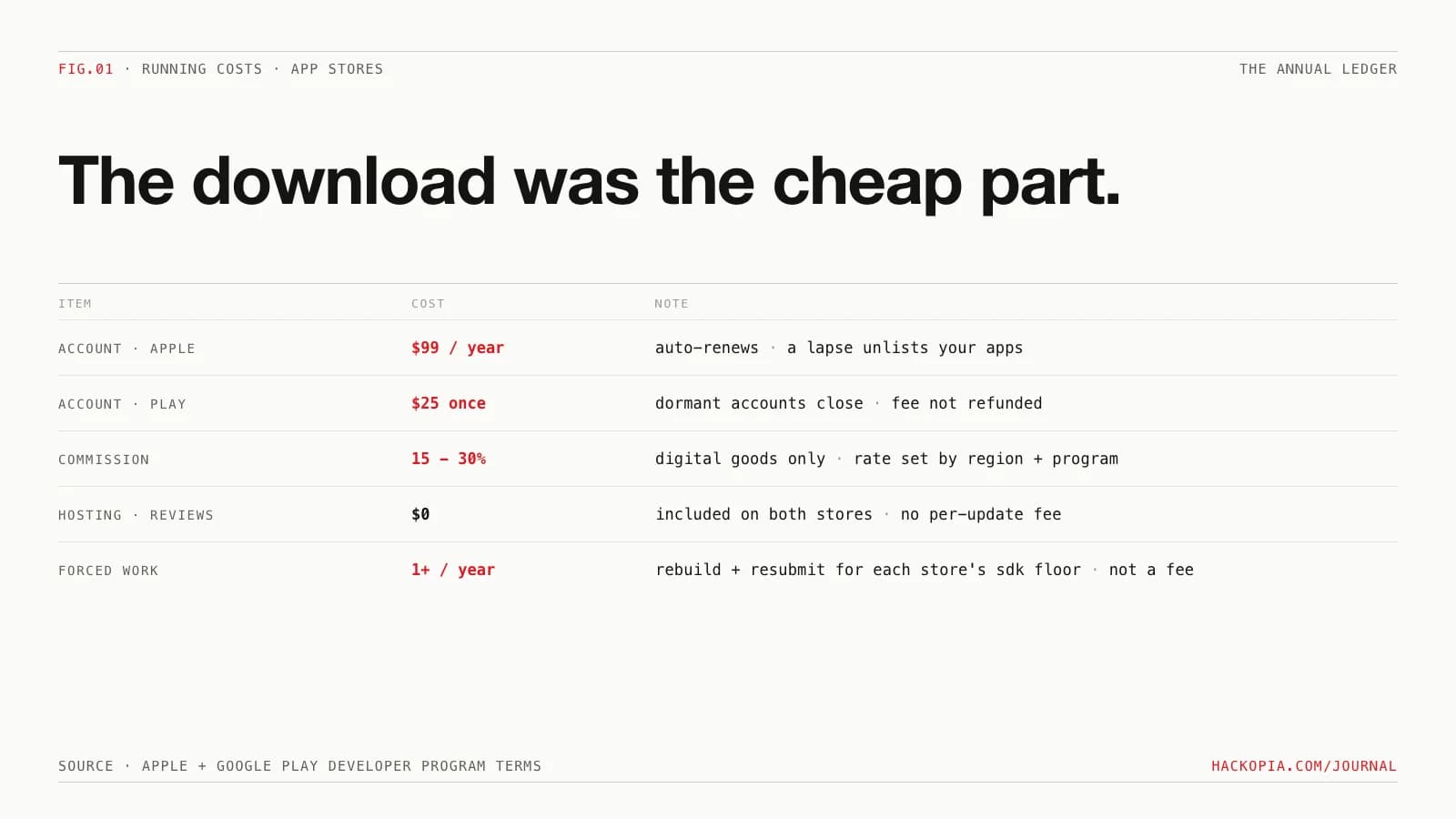
The build is paid for, the app is live, and the finance side feels finished. It is not. An app on both stores has a small invoice that repeats every year, a percentage that follows every sale, and a maintenance floor that costs time instead of money. None of it is large. All of it is easy to forget until the bill comes due in the worst way: the app quietly leaving the store.
This is the full running-cost picture for an app owner, store account by store account.
The accounts: $99 a year, $25 once
Apple's enrollment page puts the Apple Developer Program at "99 USD per membership year," and membership bought through the developer app renews automatically until cancelled. Nonprofits, accredited schools, and government entities can request a fee waiver. The important part is what a lapse does. Apple's own wording: "If you have apps and In-App Purchases on the App Store, they'll become unavailable in all storefronts if your membership expires. Apps currently on customer devices will remain installed." Renewal restores them without resubmission (for paid apps, after re-accepting the Paid Applications Agreement), but the gap is real: an expired card can unlist a paid product overnight.
Google Play is cheaper on paper: a "US$25 one-time registration fee" with no annual renewal. The catch is different. Play closes developer accounts for inactivity and does not refund the fee. For an account with apps, the criteria are: no Play Console use in 180 days, an unverified phone number and contact email, under 1,000 combined lifetime installs across all published apps, and an account more than a year old. Google sends warning emails at 60, 30, and 7 days, then the account is permanently closed.
So the fixed cost is $99 a year plus $25 once. The real risk is administrative: a dead credit card on Apple, an unwatched inbox on Google.
The percentage: the commission tables
This part only applies if the app sells anything digital: paid downloads, in-app purchases, subscriptions. Free apps pay nothing, and Google is explicit about the scale of that: "97% of developers distribute their apps and take advantage of all Google Play has to offer at no charge."
When money does move, Apple's commission on digital goods and services is 30%, reduced to 15% for members of the Small Business Program, which covers developers "who made up to 1 million USD in proceeds in the prior calendar year." Cross the million mid-year and the standard rate applies to future sales; drop back under and you can re-qualify the year after. Subscriptions get their own term: 15% for "qualifying subscriptions," which is Apple for a subscriber who has accumulated a year of paid service.
Google Play's table changed in 2026, and most articles you will find still cite the old one. Since June 30, 2026 in the EEA, the UK, and the US, and since September 30, 2026 in Australia and Japan, the service fee is install-based rather than a flat revenue tier: auto-renewing subscriptions run 10% plus a 5% billing fee where Play's billing processes the payment, other transactions run 20% plus the billing fee on new installs and 25% plus it on existing installs, with the first $1M of annual earnings at 10% plus the billing fee. Outside those regions, the older structure still applies until the rollout completes: 15% on the first $1M per year, 30% above it, and a flat 15% on subscriptions.
Two footnotes worth knowing rather than memorizing: the EU moved to unified Apple terms on October 1, 2026, with one commission table (26% through in-app purchase, less for program members, alternative payments, and link-outs) and a 5% Core Technology Commission on digital sales in apps distributed outside the App Store, and Play's external-web-link transactions carry their own rates. If your app sells digital goods to EU users, the fee sheet has more than one page.
What is free
Both stores charge nothing per update, per review, or per submission. Apple describes "unlimited hosting and bandwidth for all apps, updates, in-app purchases, machine learning models, and more, even for free apps," and collects commission only when a digital good or service sells through the app. Bandwidth, distribution, review, and listing are the included parts. The invoice items are the account and the revenue share, nothing else.
The cost that is not on any invoice
The biggest recurring obligation is not a fee at all. Both stores force a yearly rebuild and resubmission: Google Play moves its required target API level every August, and Apple requires uploads built on the current Xcode and SDK every spring. An app that misses those dates can be healthy, installed, and unable to ship. We wrote the calendar up separately in Both app stores force a yearly update, even when nothing changed, because it is a topic on its own.
For budgeting purposes, read that post's conclusion as a line item: at least one maintenance release per store per year. For a well-kept app it is days of work. For a neglected one it is a project, and it lands on the same deadline either way.
Our position
The honest running-cost budget for a small business app is three lines: $99 a year to Apple, a commission line that is zero until the app sells digital goods (then 15% or the tier you actually qualify for, not the 30% headline), and one scheduled maintenance release a year. Founders get surprised by the third line, not the first two, because no store sends an invoice for the rebuild your app needs to stay shippable.
Whoever controls the store accounts controls this budget. If an agency registered them, make sure the renewal card, the contact email, and the Play Console sign-in belong to you. A dormant-account closure or an expired membership is a solved problem at the account level and an emergency at the product level.
The takeaway
play: $25 once, dormant accounts close (60/30/7-day warnings)
apple: 30%, or 15% under $1M proceeds (small business program)
apple subscriptions: 15% after one year of paid service
play (eea/uk/us + au/jp): 10%+5% subs, 20-25%+5% other sales
play (other regions): 15% first $1M, then 30%; 15% subs
The FREE section is why running an app is cheaper than it sounds, and the FORCED line is why it costs more than the receipts suggest. Keeping accounts current and releases scheduled is the maintenance work our support and maintenance engagements cover, and it is what we run on CashTaq ourselves. If you want the real number for your app's situation, send us the store listings.
// sources
// next step
We work this way on client projects too.
Tell us what you are making. We reply with a plan, a timeline, and a price.
