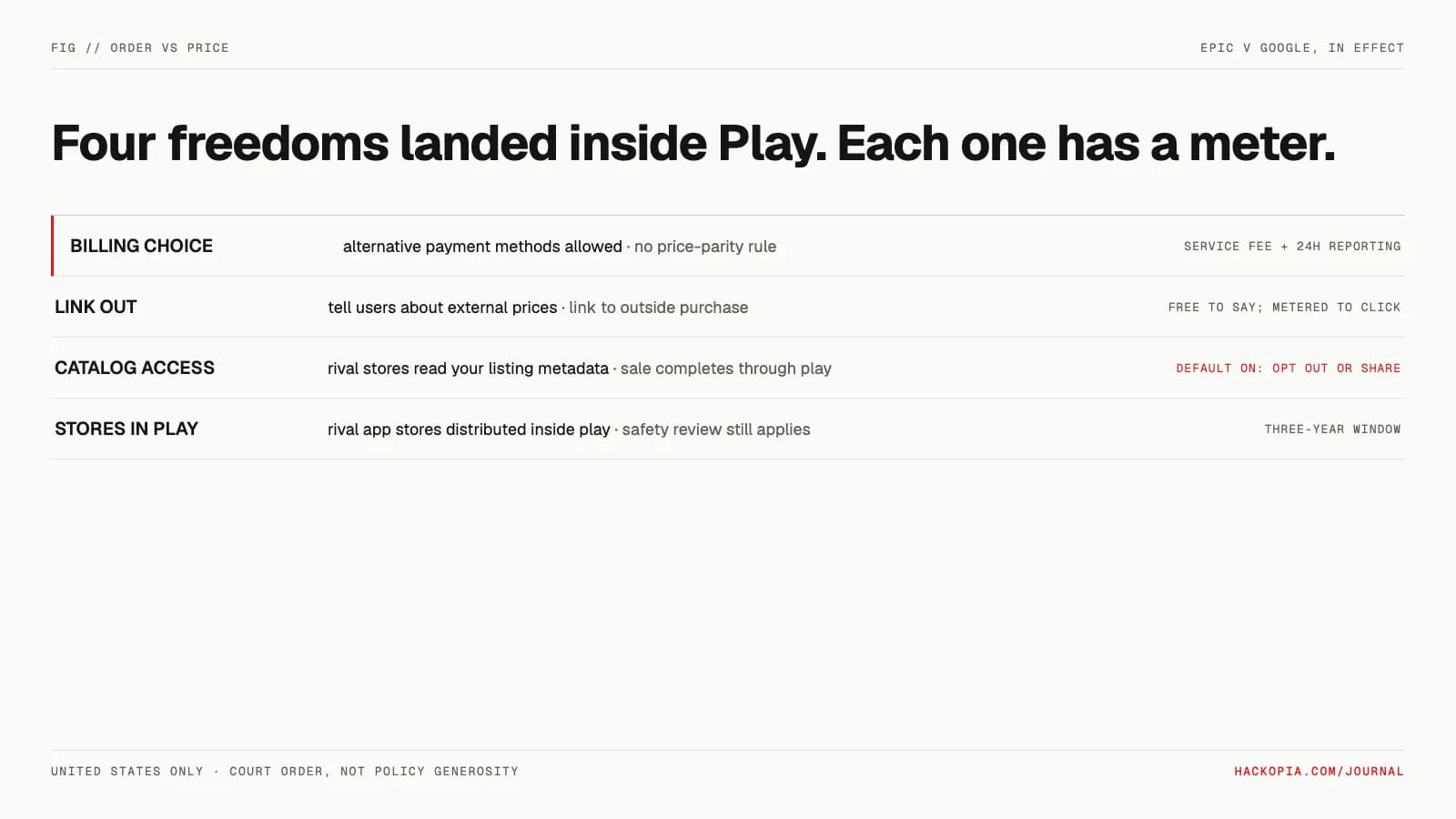
If you sell digital goods in an Android app, the rules of Google Play in the United States are no longer Google's rules. They are Judge James Donato's. On October 7, 2024 the court entered a permanent injunction in Epic v Google after the jury found Play to be an illegal monopoly, the Ninth Circuit upheld it in September 2025, and the Supreme Court declined to block it. The result is running in production now: billing choice, links out, catalog sharing, and rival stores inside Play itself. What owners miss is the fine print underneath: everything is US-only, almost everything carries a fee or a reporting duty, and the headline provisions expire on November 1, 2027.
What the injunction orders
The order's own paragraphs are clearer than the coverage. For three years from November 1, 2024, Google may not require Google Play Billing, may not prohibit other in-app payment methods, may not stop developers from telling users about alternative payment methods, and may not require pricing "based on whether Google Play Billing is used." It may not prohibit developers from "communicating with users about the availability or pricing of an app outside the Google Play Store" or from "providing a link to download the app outside the Google Play Store." Separately, Google must let third-party app stores access Play's catalog of apps, and may not prohibit the distribution of rival app stores through Google Play itself, subject to safety review "comparable to the measures Google is currently taking for apps proposed to be listed." That last pair had an eight-month build window; the three-year clock started when the systems went live on July 22, 2026.
What Google actually built
Compliance arrived in stages, and each stage has a date on Google's own US policy page. As of October 29, 2025, Play policy for US mobile and tablet apps mirrors the injunction: no billing mandate, no anti-steering, no forced price parity. On December 9, 2025 the alternative billing and external content links programs opened for enrollment. On July 22, 2026 the store-level provisions went live: US app listings (names, icons, descriptions, screenshots) became available to third-party US stores unless developers opt out in Play Console, and the "Third-party App Store on Play Program" opened, with downloads completing through Play "on the same terms as any other download." And on October 1, 2026 the meter started: enrolled developers now report transactions and pay Play service fees on them, with download-event reporting due by February 1, 2027.
One caution on sources: Google's policy page still describes the March 2026 settlement between Epic and Google as if it were pending, but the parties withdrew the modification motion on July 14, 2026 and the 2024 injunction governs. The page's program dates are accurate; its legal-status paragraph is months out of date.
What the freedoms cost
The injunction freed the channel, not the price. The external content links program lets you link US users to purchases outside Play or even to an app download Play does not manage, in exchange for enrollment, an API integration that surfaces a Google information screen, customer-support and refund duties, transaction reporting, and fees on anything completed within 24 hours of the link: 10% for auto-renewing subscriptions, 10% on the first US$1M of annual earnings, 20% standard (15% for qualifying program members), plus a fixed fee per app download event of $2.85 for apps and $3.65 for games. The alternative billing program carries the same fee structure for in-app payments that bypass Play Billing. The catalog side runs the other way: third-party stores read your listing metadata by default and sell your app through Play's rails, and Play's service fee still applies to those downloads. Opting out is a Play Console setting, not a negotiation.
Where it bites
Three catches shape the decision. First, geography: every one of these freedoms is United States only, and Play's program pages say so explicitly and repeatedly; other regions run their own newer programs (EEA external offers, the restructured service-fee tiers, the non-US "Registered App Stores" program), none of them the injunction's. Second, the sunset: the provisions in paragraphs 4 through 10 expire November 1, 2027, and Google's program pages reserve "the right to modify or terminate this program" if the order changes; anything you build on external billing needs an exit plan for that date. Third, the operational tax: the fees may be lower than the old 30%, but enrollment, the information-screen API, transaction reporting on the 24-hour attribution window, and refund and support obligations are real engineering and ops work, not a policy toggle. And on fees specifically, compare against the restructured standard Play billing rates before assuming the link-out is cheaper; our breakdown of what the stores take after the court rulings has the arithmetic.
Our position
Use what is free immediately: telling US users about external pricing and cheaper web options is now protected speech under the order, and for catalog sharing we would leave the default on, because a third-party store listing costs you metadata you already published and completes through Play anyway. Treat the paid programs as math, not ideology: external content links make sense when your margin survives a 10-20% fee plus per-install charges and you already have the support surface to handle off-store purchases; alternative billing makes sense at transaction volumes where the percentage gap between Play's billing fee and your processor's rate funds the reporting integration. And put November 1, 2027 in the roadmap now: a product that depends on court-ordered freedom needs a plan for the day the court order ends.
The takeaway
every program is us-only by the order's own terms
link out is allowed under policy since oct 2025
(15% program), $2.85/$3.65 per install, all on
transactions within 24h of the link; reporting due
downloads still run through play with fees
catalog/store programs run 3 years from jul 2026;
google can terminate if the order changes
Store policy is a moving part we price into every app build in our custom software work, including commerce builds like Grain and Vine. If you are weighing Play Billing against an external checkout, send us the numbers and we will run them with you.
// sources
// next step
We work this way on client projects too.
Tell us what you are making. We reply with a plan, a timeline, and a price.
