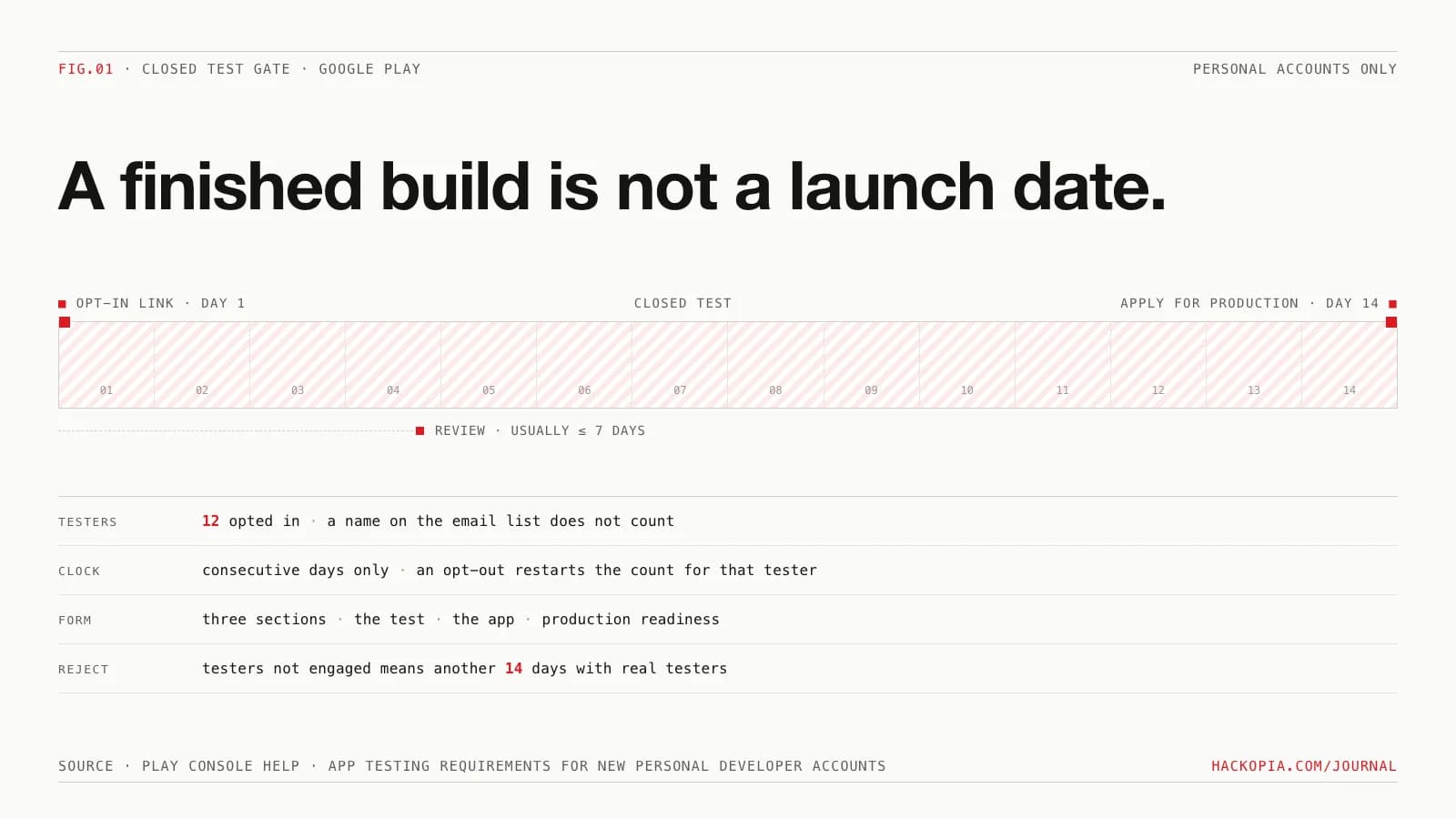
If you create a personal Google Play developer account today and finish your app tomorrow, you still cannot publish it. Google's testing requirements page states the rule directly: "Developers with personal accounts created after November 13, 2023, must run a closed test for their app with a minimum of 12 testers who have been opted in continuously for at least 14 days." Until you meet that, the Production and Pre-registration sections of Play Console stay disabled, and the open testing track is unavailable too.
This catches founders and clients who plan a launch date around when the build is done. The build being done is the start of a two-week gate, not the finish line. This post covers what the rule asks, what Google checks when you apply, and how to plan around it.
Who the rule covers
The requirement is written to apply only to personal developer accounts created after November 13, 2023. Organization accounts and personal accounts created before that date are outside its stated scope.
It also changed once already. When Google announced the policy in November 2023, the bar was 20 testers. An update on the same post, dated December 11, 2024, says: "We've heard from some developers, who are starting with small audiences, that getting 20 testers has been challenging. So to reduce the difficulty for smaller developers but still maintain a high quality app experience for everyone, starting today, we're requiring 12 instead of 20 testers for personal developer accounts." The 14-day duration never changed.
The practical implication: a business registering a Play account for its app should register an organization account, not a personal one. The rule targets individuals.
What "12 testers for 14 days" actually means
The count is measured at the moment you apply for production access, against the preceding 14 days, and the days must be consecutive. Google's FAQ on the page is precise: "Testers who opt in, test for fewer than 14 days, and then opt out do not count toward the requirement. If a tester opts out and opts back in later, the 14 days must be consecutive to count toward the minimum requirement of 12 continuous opted-in testers."
Two details make this harder than it sounds:
- Opted in means opted in. Being on your tester email list only makes someone eligible. Per the test setup documentation, each tester has to open the opt-in link and complete enrollment. Twelve names on a list with ten people who clicked through is ten testers.
- Track eligibility is exclusive. A user who opts into your app's internal test "is no longer eligible to receive an open or closed test." They have to leave the internal track first. If you run internal testing during development, move your testers to the closed track before the clock starts.
The help page's own instruction to developers is worth repeating to every tester: they "need to remain opted in to your closed test continuously for at least 14 days."
What Google asks when you apply
Passing the 14 days does not publish anything. It makes a button appear. From the help page: Dashboard in Play Console, then "Apply for production," then a form in three sections.
About your closed test asks how easy it was to recruit testers, whether testers used all available app features, whether their usage matched expected production behavior, and a summary of the feedback you received and how you collected it.
About your app/game asks you to specify the target audience, describe the app's value proposition, and estimate installs for the first year.
About your production readiness asks what changes you made based on the closed test and how you determined the app was ready for production.
This is not a formality. The page says the answers "help verify that apps have been thoroughly tested before publication on Google Play," and describes the process as protecting users "from low-quality apps," preventing "malware distribution," and reducing fraud. The announcement post adds the commercial reason: Google says apps that use its testing tools have on average three times the installs and user engagement of those that do not.
What rejection looks like
After you apply, the page says the review "usually takes seven days or less, but can occasionally take longer," and the result goes to the account owner by email.
A rejection does not reset you to zero, it resets you to the start of the test. Google's rejection email names possible reasons, including testers not being engaged during the closed test and testing best practices not being followed, and gives the remedy: run the closed test for another 14 days "with real testers" before applying again.
So the realistic floor for a new personal account is not 14 days. It is 14 days of testing, plus a review that is usually a week or less, assuming the first application passes. A rejected application costs another two weeks plus another review.
Our position
Plan the test before the build ends, not after. Twelve engaged testers is a recruitment problem, and recruitment is slower than anyone expects. Google's own guidance points at personal and professional networks and communities where your target users already are. Whoever they are, they need to know three things: click the opt-in link, stay opted in for 14 consecutive days, and actually use the app, because "testers were not engaged" is a named rejection reason.
The feedback questions in the application form also mean a closed test where nobody reported anything is a weak application. Give testers a feedback channel and ask them for responses. The answers you write in that form should describe a real test, because the person reading them is deciding whether one happened.
And if the app belongs to a business, make the account decision before registering anything: the rule as written covers only personal accounts, and switching account types later is its own project.
The takeaway
Run this against any Play launch on a new personal account:
business app? register an organization account instead
more than 12 is safer: opt-outs stop counting
The RECRUIT and CLOCK lines are where launch dates die. Add them to the plan the day the account is created. Testing and release gates like this are part of what our custom software work schedules around, and the same Play Console rules are what CashTaq ships under. If you want a launch plan that includes the 14 days instead of tripping over them, send us the timeline.
// sources
// next step
We work this way on client projects too.
Tell us what you are making. We reply with a plan, a timeline, and a price.
