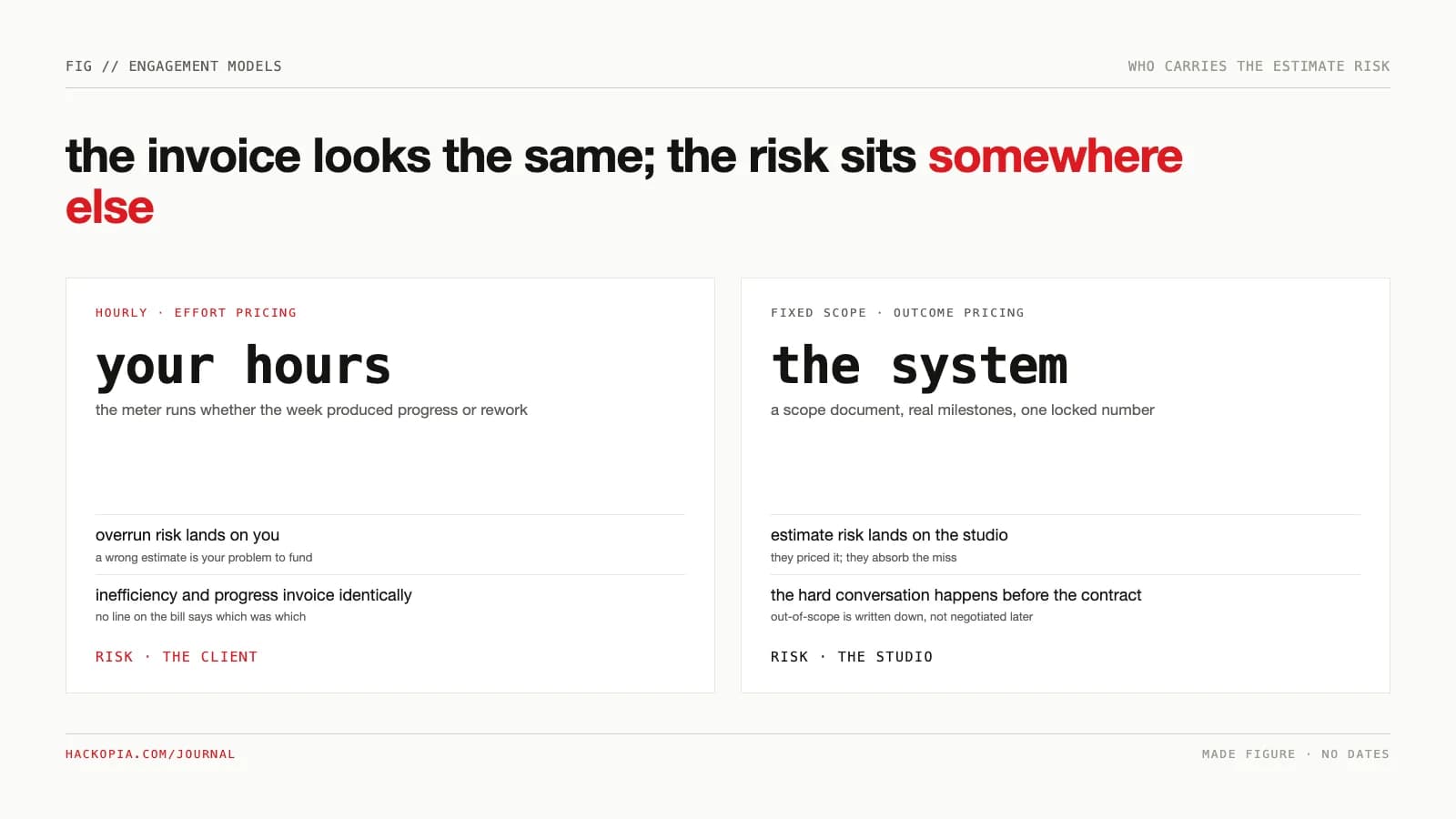
The first question every founder asks a studio is "how much will it cost," and the honest answer depends entirely on what the studio is selling. Two models dominate. Hourly billing prices your project in effort: you buy the team's time and own whatever it produces. Fixed scope prices the outcome: you buy a defined system at a locked price. The difference sounds like accounting. It is actually about who carries the risk when the plan meets reality.
What hourly actually sells you
Under hourly billing the invoice is the same whether the week produced progress or rework. That is the model's structural problem: the studio's revenue grows with the hours, so every inefficiency in the project is someone else's problem, specifically yours. A scope that was vague gets expensive slowly. A feature that needed two attempts costs double the attempt it should have been.
Hourly is not a scam. It is the honest model for work that genuinely cannot be scoped: rescuing a codebase nobody has read, research whose whole point is discovering what is needed, support work that scales with incidents. The problem is that most projects are not that, and hourly billing lets a studio avoid the one thing clients are actually paying for: an opinion about what the project should contain.
What fixed scope actually sells you
A fixed-scope engagement is a different product entirely. The studio does the estimate up front, prices the risk into the number, and commits to the outcome. You get a scope document with real milestones and a real price; if the estimate was wrong, that is the studio's problem to absorb, not yours to fund.
This is how we work, and the site says it plainly: most agencies sell hours, we sell working systems. Every engagement is scoped, built, and supported by the people you actually talk to, with weekly demos so you watch the system grow and can redirect early. The scope document is the commitment device: it forces the hard conversation to happen before the contract, not during the third invoice.
Where each model fails honestly
Fixed scope fails when the scope was wrong. If the discovery was rushed, the document describes a product that is not quite the product, and every change becomes a negotiation. The mitigation is not refusing the model; it is a scope conversation honest enough to write "out of scope" items down where both sides can see them, plus weekly demos that surface drift while it is cheap to fix.
Hourly fails quietly. There is no moment where it looks wrong; the project just costs more than expected and nobody can point at the week where it went sideways, because inefficiency and progress invoice identically. The mitigation is a hard cap with a checkpoint, but at that point you have reinvented fixed scope with extra steps.
The middle ground is still scope
Studios sell hybrids that sound like compromise: capped hourly, time-and-materials with a ceiling, milestone-billed work. Inspect them and they all resolve to the same question: whose number ends the conversation. A capped hourly contract is hourly billing with a maximum, and the maximum is where the risk got parked; the work either fits under it or the contract reopens. Milestone billing is fixed scope wearing smaller clothes, which is fine, provided the milestones are real deliverables and not "sprint four." The honest version of every hybrid names what happens when the estimate is wrong. The dishonest version delays that answer until the invoice makes it for you.
The questions that expose the model
When you are evaluating a studio, the pricing answer you get tells you which model is underneath, and the follow-ups tell you how honest it is:
"you get a fixed plan with milestones" = outcome pricing
under fixed scope, the estimate risk is theirs
that cannot produce one is billing for the discovery
scope has an answer that is not "more hours"
decks because you can redirect while it is cheap
means the exclusions get negotiated later, at your cost
Our position
We sell fixed scope because the alternative puts the risk on the side of the table least equipped to carry it. The client should not need to audit our weeks to get a fair price; the studio should be confident enough in its own estimates to sign them. If a project genuinely cannot be scoped, the honest answer is to scope the discovery instead: a small fixed engagement that produces the document a real estimate needs. It is the same discipline we run on our own product, CashTaq, where the scope document existed before the first screen did.
The takeaway
Fixed scope and hourly are not two prices for the same thing; they are two different allocations of risk. Buy hours for work that cannot be defined, buy the outcome for everything else, and treat any studio that cannot produce a written scope as one that has not decided what your project is yet.
If you have a project brief and want a scoped number instead of a meter running, the intake is one message on every custom software engagement: send us the brief. How to write that message is its own post, here.
// sources
// next step
We work this way on client projects too.
Tell us what you are making. We reply with a plan, a timeline, and a price.
