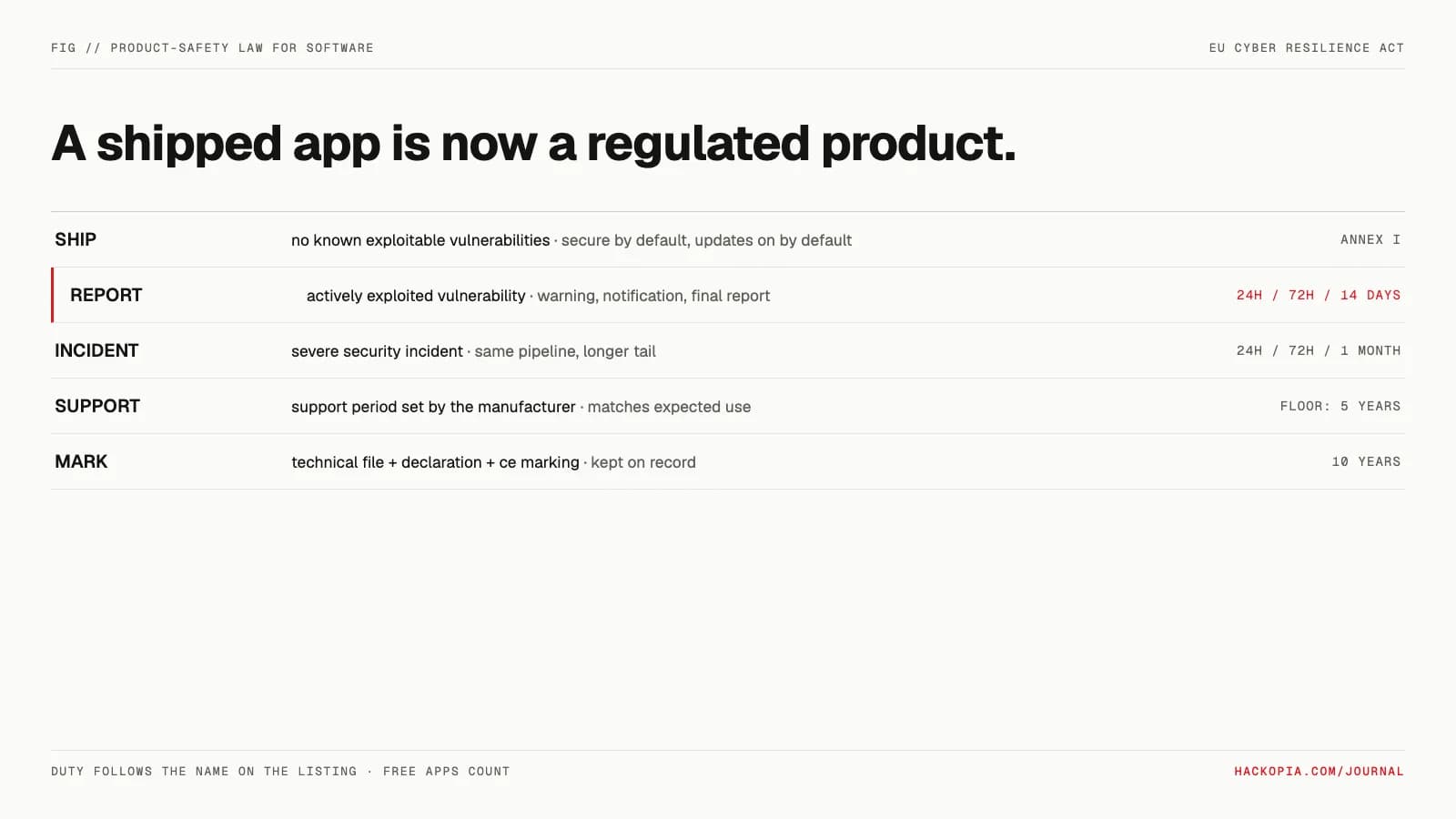
The EU's Cyber Resilience Act does to software what product-safety law did to toasters: if you put it on the market, you own its security for its lifetime. Regulation (EU) 2024/2847 entered into force in December 2024, and its scope is written to catch apps without naming them: a "'product with digital elements' means a software or hardware product and its remote data processing solutions." A mobile app qualifies the moment it connects to anything, and the Commission's own guidance names standalone software downloaded from an app store as covered. The part teams have not clocked: the reporting duty is not coming. It started September 11, 2026, and it covers products already on the market.
What the law asks, in three loads
Ship clean. Annex I requires that a product be "made available on the market without known exploitable vulnerabilities" and "with a secure by default configuration," with security updates "installed within an appropriate timeframe enabled as a default setting." Ship with a known hole and you have shipped a non-conforming product, not a bug.
Report in hours. Article 14 sets a three-stage clock on any actively exploited vulnerability a manufacturer becomes aware of: an early warning "in any event within 24 hours," a full vulnerability notification within 72 hours, and a final report within 14 days of a fix existing. Severe security incidents get the same treatment: 24 hours, 72 hours, then a final report within a month. Everything goes through the Single Reporting Platform to the coordinating CSIRT and ENISA at once, and this duty applies to every covered product on the Union market today, including ones shipped before the main obligations start.
Support for years. The manufacturer sets a support period reflecting how long the product is expected to be in use, with a floor of five years (shorter only where expected use is under five), and each security update issued during it must remain available for a minimum of ten years. "We stopped maintaining that version" is a sentence the regulation prices.
On top of those sits the conformity chain: before placing the product on the market, the manufacturer draws up technical documentation, runs the conformity assessment (self-assessment is the default route; higher classes route through notified bodies or a European certification scheme), issues an EU declaration of conformity, and affixes the CE marking. Documentation and declaration are kept for at least ten years.
Who carries the duty
Not the agency that wrote the code. The manufacturer is "a natural or legal person who develops or manufactures products with digital elements or has products with digital elements designed, developed or manufactured, and markets them under its name or trademark, whether for payment, monetisation or free of charge." Two consequences clients miss. First, "for payment" is not the trigger: a free app is a regulated product the same as a paid one. Second, when a studio builds an app and the client ships it under the client's developer account and trademark, the manufacturer duties sit with the client, because they are the one who "has products ... manufactured, and markets them under its name." A studio shipping its own apps under its own name carries the full set itself. Either way, the duty follows the name on the listing, not the name on the invoice.
The penalties make it worth reading the org chart: up to EUR 15 million or 2.5% of worldwide annual turnover, whichever is higher, for violations of the Annex I requirements and the Article 13 and 14 obligations. One carve-out: micro and small enterprises are shielded from the fine for the 24-hour early-warning deadline specifically, though the 72-hour notification still carries the full exposure.
The dates, exactly
The regulation is already law; only parts of it are asleep. It entered into force December 10, 2024. The conformity-assessment body rules (Articles 35-51) have applied since June 11, 2026. Article 14's reporting duties have applied since September 11, 2026. The main obligations (secure-by-default, support period, CE marking) apply from December 11, 2027. Products placed on the market before that date escape the conformity chain unless substantially modified, but they do not escape the reporting clock.
Our position
Treat the CRA as two projects with two deadlines, not one. The urgent one is process, and it is overdue if you ship into the EU: a channel that learns about exploited vulnerabilities in your product, an owner who can file to the Single Reporting Platform inside 24 hours, and a template for the 72-hour notification, because the clock does not pause while you find a lawyer. The slower one is the product file: technical documentation, a declared support period, an update mechanism that is on by default, and the conformity paperwork, all due before December 11, 2027. If you are the client whose name is on the store listing, do not assume your agency carries this; read the definition again. And if your app is free, do not assume the law prices by revenue; it prices by market presence. For the accessibility side of the same regulatory wave, the EU accessibility act post covers the parallel duties.
The takeaway
connects to a device or network; free counts
name on the invoice; client > agency
72h notification, final report 14 days after
fix; incidents: 24h/72h/1 month via srp
2026, including to already-shipped products
secure defaults, updates on by default
issued security updates stay available 10y
whichever is higher
a vuln inbox that reaches them, a template
Compliance scope like this is part of what we itemize before a build in our custom software work, including apps we ship under our own name like CashTaq. If your product has EU users and nobody owns the 24-hour clock, send us the store link.
// sources
// next step
We work this way on client projects too.
Tell us what you are making. We reply with a plan, a timeline, and a price.
