On August 25, 2025, Firebase Dynamic Links shut down. Every page.link URL and every custom-domain link the service hosted stopped working, and Google's own deprecation FAQ is blunt about the replacement situation: if you need "full feature parity," the recommendation is to "use other deep-linking service providers / vendors," naming Branch, AppsFlyer, Adjust, Airbridge, Bitly, Kochava, and Singular, with the explicit note that "these providers have not been vetted by Google." Fifteen months later the picture has not changed: there is no first-party API that does what Dynamic Links did for free, and understanding why tells you which replacement your app actually needs.
The constraint
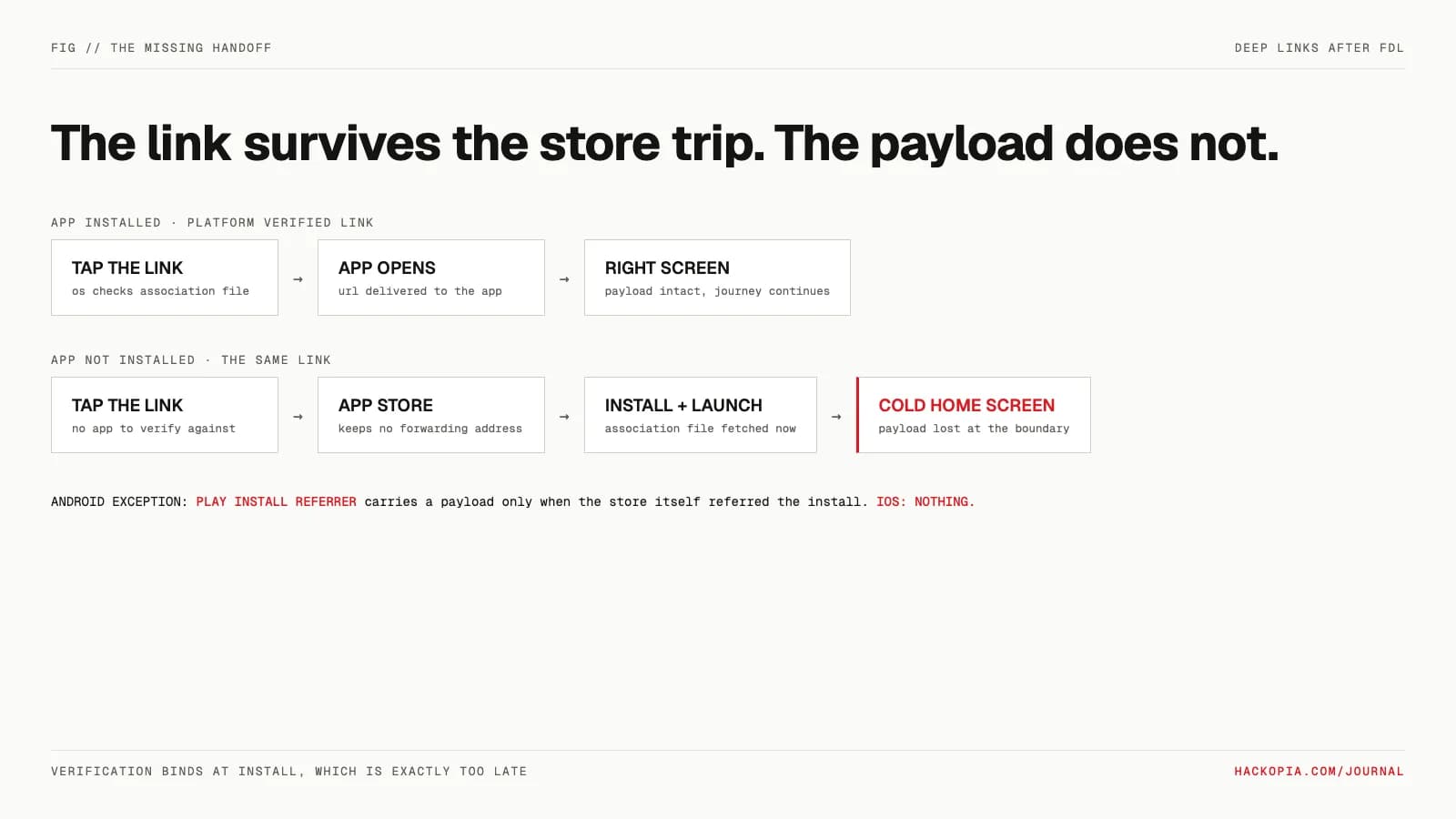
A dynamic link did three jobs in one URL. It routed the tap to the right store for the device, it opened a specific screen if the app was already installed, and the hard one: it carried a payload through the store install, so a user who tapped "join the Ali family budget" in a message, got bounced to the store, installed, and launched, still landed inside the right family. That third job is the deferred deep link, and it is the feature that has no free replacement, because the mechanism it relied on no longer exists.
The options
Universal Links (iOS) and App Links (Android). The platform-native answer and the one Google's migration guide pushes: host a signed association file on your own domain, declare the domain in the app, and the OS opens matching URLs directly in the installed app. Free, private, and the only option with zero vendor dependency. The coverage gap is structural, detailed below: it handles every case except the install.
Smart App Banners (iOS). Safari can render an install/open banner on your own website that survives into the app. Google's migration guide suggests it as the closest iOS substitute for journey continuation, with the hedge that it "potentially" provides continuation. It only fires on your own site in Safari, not on links shared in messages or social apps, which is where invite and share links actually travel.
Play Install Referrer (Android). The Play Store passes a referrer string back to the app after install, and Dynamic Links itself used this under the hood on Android. Real mechanism, narrow scope: the referrer exists only for installs that arrived through a Play Store URL, so a link opened in WhatsApp, an email client, or a browser that did not route through the store carries nothing. iOS has no equivalent at all; AdAttributionKit attributes ad-campaign installs to networks with 24-48 hour postbacks and delivers no link payload to the app.
Third-party deep-link vendors. Branch, AppsFlyer, and friends still offer true deferred deep links. Their mechanism on iOS is matching a pre-install click to a post-install signal (fingerprinting or attribution APIs), which works but drags in an SDK, a privacy-manifest entry, and a vendor contract for what used to be a free Firebase feature.
The mechanism
The gap is not a missing feature; it is a missing moment. Both platform systems bind the domain to the app at install time. Apple's apple-app-site-association and Android's assetlinks.json, both served from /.well-known/ on your domain, are fetched when the app installs:
{
  "applinks": {
    "details": [{ "appIDs": ["TEAMID.com.example.app"], "components": [{ "/": "/invite/*" }] }]
  }
}
[{
  "relation": ["delegate_permission/common.handle_all_urls"],
  "target": {
    "namespace": "android_app",
    "package_name": "com.example.app",
    "sha256_cert_fingerprints": ["AB:CD:..."]
  }
}]
The verification exists to prove you own both sides of the link, which is exactly why it cannot help a click that happened before the install: when the user taps the link, the app does not exist on the device, so there is nothing to hand the payload to, and the association handshake has not run yet. The store sits in the middle and keeps no forwarding address. On Android the Install Referrer is the one slot the store left open, and it only exists for installs the store itself referred. The deferred deep link did not get replaced; the hole it filled was paved over.
Where it bites
The honest inventory, matching Google's own feature table: platform links cover "deep-linked content in your app (when already installed)" and nothing else on the checklist. Store routing, deferred deep links, click analytics, short links, and social-share metadata all become your problem. That bites in three places. Referral and invite flows lose their carry-through: the user who installs from a shared link arrives at a cold home screen unless you gate the payload behind account creation or a code. Install-side analytics lose continuity: the click-to-install chain that Dynamic Links reported is gone unless a vendor reconstitutes it. And every replacement path that touches attribution on iOS inherits the privacy cost, because fingerprint-based matching is precisely the practice App Tracking Transparency was built to require consent for.
The smaller bite: universal links on your own domain now carry weight they did not have. The association files make your domain part of the app's trust boundary, and Apple's own docs warn that "universal links offer a potential attack vector into your app, so make sure to validate all URL parameters." Owning the domain, the TLS certificate, and the file hosting is now infrastructure, which is the same ownership argument as the parts of your app that are hard to move.
The numbers
- Dynamic Links: deprecated August 2023, frozen to critical fixes August 19, 2023, shut down August 25, 2025. The FAQ's own checklist for evaluating replacements has six features; platform links cover one.
- App Links: automatic verification on Android 6.0 (API 23) and higher; hosts must verify or the app does not become the default handler.
- Play Install Referrer: library version 2.2 (January 2021), requires Play Store app 8.3.73+, returns the referrer string plus click and install timestamps.
- AdAttributionKit: iOS 17.4+, postbacks arrive 24-48 hours after the user launches the app, attributes campaigns, carries no link payload.
Our position
Default to platform links on your own domain and accept the deferred-deep-link loss, because unless you run paid referral or attribution-driven growth, the missing feature costs less than the vendor it takes to restore it. Design the flows that used to depend on it accordingly: referral codes, claim-on-signup, a web page that re-prompts the install with the payload in the URL. Reach for a deep-link vendor only when the carry-through is measurable revenue, like paid referral or attribution-driven growth, and price the SDK, the privacy disclosure, and the ATT consent question as part of that decision. If you already shipped with platform links, audit what your old page.link URLs in old emails, QR codes, and social posts now resolve to: dead links in the wild are your listing's problem now, not Firebase's.
The takeaway
domain; aasa + assetlinks fetched at install
first-party replacement; the hole was paved over
only; nothing arrives from a browser or chat tap
measures campaigns, carries no link payload
fingerprinting: sdk + privacy manifest + att
consent question are part of the price
only where carry-through is measurable revenue
Deep links and the domain they now depend on are part of the ownership layer we scope into mobile builds in our custom software work, storefronts like Grain and Vine included, same as the accounts and keys in who owns your app. If your share links still point at page.link, send us the URLs.
// sources
// next step
We work this way on client projects too.
Tell us what you are making. We reply with a plan, a timeline, and a price.
