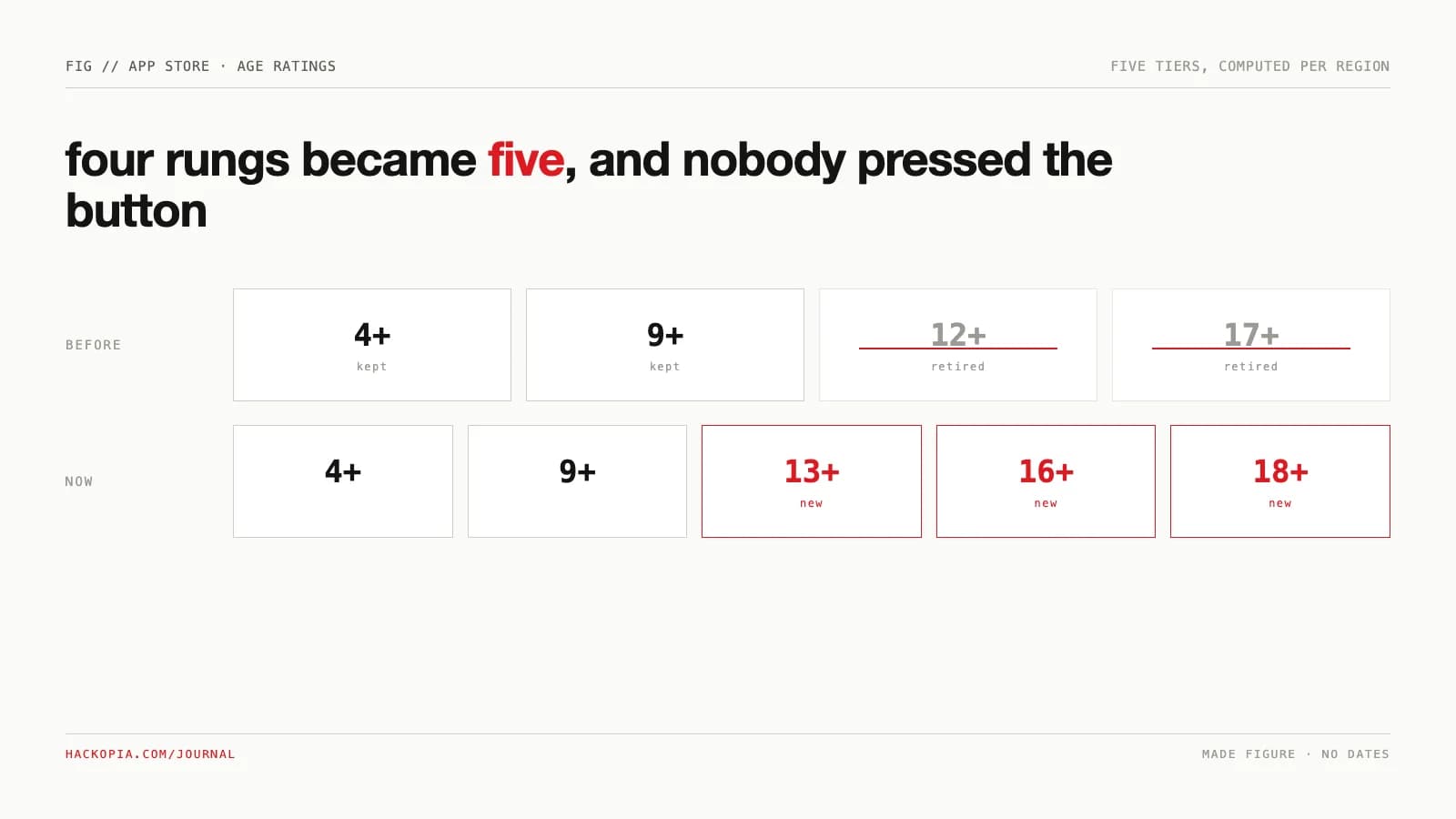
Every app on the App Store was re-rated last year. On July 24, 2025 Apple announced that "ratings for all apps and games on the App Store have been automatically updated to align with this new system," and the new questionnaire became required for submissions. The old four-tier ladder (4+, 9+, 12+, 17+) became five: 4+, 9+, 13+, 16+, 18+. Twelve and seventeen are gone; nine survived.
If your listing already went through review after January 31, 2026, you answered the new questions then. If it has not, your next submission will hit them. And a second wave lands November 16, days from now. This post covers the new tiers, the questionnaire, the regional quirks, and the deadline worth circling.
What the new system is
The updated system "adds 13+, 16+, and 18+ to the existing 4+ and 9+ ratings," in Apple's words, and ratings are now "assigned to each country or region," which can vary "based on region-specific suitability standards." The new ratings show on devices running iOS 26, iPadOS 26, macOS Tahoe, and their siblings; older OS versions still display the legacy ladder.
No developer action created the re-rating. Apple recomputed every listing from your existing answers, and the deadline for answering the new questions was January 31, 2026, "to avoid an interruption when submitting your app updates in App Store Connect." Miss it and your app is not delisted; your updates are. You can also now set a higher rating than Apple's computed one if your app's minimum age policy requires it.
What the questionnaire now asks
The form has three parts. Content descriptors across five groups (mature themes, medical or wellness, sexuality or nudity, violence, and chance-based activities including loot boxes and gambling) are answered on a frequency scale: none, infrequent, frequent. In-app controls like parental controls and age assurance are presence declarations. Capabilities is the section where feature choices become rating choices: unrestricted web access, user-generated content, social media, messaging and chat, and advertising. Not every capability costs you tier points, but two of them set floors all by themselves, which is why the product decision and the rating decision are the same conversation.
The answers map to tiers in Apple's published table. Unrestricted web access alone lands an app at 16+. Frequent realistic violence or gambling means 18+. Graphic sexual content at any frequency produces "Unrated," which "can't be published on the App Store" at all.
What lands November 16
On November 16, 2026, App Store Connect gains two new content descriptors, verbatim from Apple's announcement:
- Shared Location: "sharing of real-world location with another person or group"
- Dating and Relationships: "features that enable dating or relationship connections between real people and/or a virtual companion that engages a user in sexual or romantic content"
"All apps must have these declarations completed by January 12, 2027," and the teeth are real: "apps that include Dating and Relationships receive a minimum age rating of 18+." Virtual companions count. Brazil goes further by regulation: Shared Location requires A16 and Dating requires A18 there.
The regions do not follow the same math
The global table is the default, not the law. In Korea, Games and Entertainment apps get region-specific values (All, 12+, 15+, 19+) computed by Apple under local GRAC rules, and apps holding an official GRAC classification can override it. An October 2026 change there moved infrequent profanity or crude humor and infrequent mature or suggestive themes from "All" to 12+. Australia's regional 15+ tier was updated to 16+ effective June 18, 2026, and the same Apple announcement moved Vietnam to its own ladder under local decree. If your app sells worldwide, the rating on your listing is a map, not a number.
The other store delegates the whole thing
Google Play does not compute its own rating at all. "Content ratings on Google Play are provided by the International Age Rating Coalition (IARC)," and one questionnaire produces per-region labels from ESRB, PEGI, USK, ClassInd, and the Australian board automatically. The enforcement is blunter too: "apps without a content rating will be removed from the Play Store," where Apple's stated consequence was only interrupted updates.
Our position
Treat the rating questionnaire as part of the listing, not paperwork. The capabilities section is where honest answers get expensive: an app that ships unrestricted web access is 16+ by definition, so the feature decision and the rating decision are the same decision. Answer the two new descriptors the week they land rather than the week of your next release, because a rating bump is also a marketing fact your listing wears in public.
The takeaway
Check your listing against this before your next submission:
12+ and 17+ retired, every app re-rated automatically
not the listing itself
in-app controls and capabilities
alone is 16+; the feature and the rating are one decision
relationships; answer by jan 12, 2027
companions included; brazil forces a16/a18
for games/entertainment; australia moved 15+ to 16+
labels; no rating at all means removal
Store questionnaires like this are the unglamorous part of shipping we scope into every custom software build, and the standard apps like CashTaq submit under. If your listing's rating is about to change under it, send us the store link.
// sources
// next step
We work this way on client projects too.
Tell us what you are making. We reply with a plan, a timeline, and a price.
